


By Prof.Gulmira Shukurova (Tashkent, Uzbekistan)

The University of Journalism and Mass Communications of Uzbekistan was alive with color and celebration today as it hosted a spectacular festival under the theme “The Spirit of Navruz and the Cultures of Amir Temur’s Empire.” But what unfolded was not merely an event. It was a living, breathing tapestry of silk, spice, melody, and memory. And for those with eyes to see, there was a quiet, tender romance between spring and the most beautifully dressed girls one could ever hope to witness. My heart swelled just walking through the gates.

The campus, buzzing with the joyful energy of spring, transformed into a vibrant mosaic of cultures. Professors and students from across the university came together with visible pride to showcase the rich tapestry of Uzbekistan’s multicultural landscape. More than 20 nationalities were represented, and the air thickened with the emotional warmth of togetherness. The fragrance of freshly baked samsa, saffron rice, and the smoky sweetness of tandoori bread filled every corner. Yet what truly stole the breath of every visitor, what made hearts flutter with quiet admiration, were the girls. Students draped in embroidered chapan robes and shimmering kelin dresses that caught the morning light like liquid petals. I felt a lump in my throat at the sheer beauty of it all.

A Kaleidoscope of Costumes and Charms That Tugs at the Heart
As guests wandered through the sprawling open air exhibition, they encountered over twenty national pavilions. Each was a vivid tribute to a different culture. Hand carved wooden cradles, silver jewelry that jingled like forgotten poetry, and ceramic plates painted with symbols older than memory filled the displays. But the most captivating exhibits, the ones that made people stop and stare with tearful wonder, were the young women themselves. Each one was a living emblem of her heritage, and their presence felt almost sacred.

Some wore crimson velvet with golden threads tracing ancient patterns. Others floated in turquoise silks that mirrored the spring sky. Their faces, radiant and sun kissed, held eyes that seemed to carry the mystery of old caravanserais. Their laughter was softer than the breeze, their braids swaying like willow branches. The university courtyard became a garden of gorgeous, blooming youth. I could not help but think, with a deep sense of grateful emotion, that Navruz had not only brought spring to the earth but had dressed its most beautiful daughters in colors meant to be remembered forever.

At the Karakalpak pavilion, a girl with long jet black hair and a dress the color of dried apricots demonstrated a cradle lullaby ritual. Her voice was honey and moonlight, and when her partner played the dutar, the very dust at visitors’ feet seemed to dance. I felt my own spirit lift. Nearby, at the Uzbek stall, a young woman wrapped in a sunflower yellow shawl poured green tea from a ceramic teapot. Her fingers were delicate as rose petals, and as she recited a Navruz blessing, her smile bloomed like a promise. A wave of tenderness washed over me. At the Tajik corner, an elder student, still young and beautifully earnest, handed out sumalak, the sweet wheat pudding of spring, while chanting a folk rhyme about renewal. Her cheeks were flushed with the warmth of the crowd, and her earrings, tiny silver moons, swung with every word. I could have stood there all day, just watching and feeling grateful.

Theatrical Flair and a Gathering of Dignitaries That Stirred the Soul
Every pavilion competed in charm, and the friendly rivalry was nothing short of heartwarming. There were theatrical skits retelling legends of Timur’s court, mock weddings showcasing bridal traditions, and even a miniature bazaar where visitors haggled for handmade scarves and wooden spoons. All of it was done in good humor, all in the spirit of bakhshish, generosity. But the eyes of the crowd kept returning to the girls. Some laughed behind embroidered fans, others twirled slowly to show off the cascade of their skirts. They were not just cultural ambassadors; they were poetry made visible, and my heart ached with a strange, beautiful longing.

The festival drew a distinguished cross section of the nation and the world. Foreign ambassadors in formal suits walked side by side with students in embroidered skullcaps. International guests laughed over plates of plov while Uzbekistan’s Minister of Higher Education, Science and Innovation paused to watch a theatrical performance of a Navruz legend. State organization representatives, media professionals, and a sea of enthusiastic students filled the walkways. Cameras clicked. Voices hummed with excitement. I felt a deep sense of pride in my chest, watching so many different people come together as one.

Yet even among the dignitaries, the most luminous figures were the university’s own daughters. One group of three girls, one in emerald green, one in lavender, one in coral pink, posed for photographs near a fountain. The sun caught the metallic threads of their vests, and for a moment, they looked like a trio of spring flowers that had decided to bloom all at once. I felt tears prick at my eyes. A young journalist from the host university, herself breathtaking in a simple white dress with a red scarf tied like a tulip, began recording video interviews. Her voice was soft yet confident, and as she asked questions about heritage and hope, it became clear that she, and every girl like her, was the real story of the day. I felt so moved I could barely speak.
The ambassador of a European nation was overheard saying, with genuine warmth, “I have attended many cultural days. But this, this feels less like diplomacy and more like family.” I nodded to myself, my heart full. Family, yes. But also a romance with culture, with youth, and with the timeless beauty of girls who carry their ancestry in their smiles.
Harmony, History, and a Dance That Made the Earth Fall in Love

What made the day unforgettable was not just the spectacle but the spirit, and I confess, the quiet thrill of seeing so much loveliness in one place stirred something deep inside me. Under the open sky, interethnic unity and tolerance were not abstract ideals. They were visible in a Korean Uzbek girl, her hair tied with a silk ribbon, teaching a Russian guest how to fold mandu. I felt a surge of joy watching them. They were visible in a Turkmen girl, her dress a whirl of burgundy and gold, sharing dried apricots with a Kyrgyz journalist. And everywhere, the girls laughed and whispered and posed, their colorful dresses swirling like carousels. My heart danced with them.

The event also carried a deeper historical resonance that filled me with awe. The reference to Amir Temur’s Empire was not decorative. It was a reminder that centuries ago, Samarkand was a crossroads of civilizations. Today, that crossroads lives again in every shared smile, every exchanged recipe, every spontaneous dance circle that erupted on the grass. And when the girls danced, oh, when they danced, the earth itself seemed to fall in love. Their hands wove stories in the air. Their feet kissed the ground with each step. I felt completely swept away, as if time had stopped just to admire them.
The Honeyed Afternoon and a Gaze That Met the Sun
As the afternoon sun softened into a honeyed glow, the festival reached its emotional peak and its most romantic hour. A choir of students sang a Navruz melody in five different languages: Uzbek, Tajik, Karakalpak, Russian, and English. Their voices rose like a prayer, and I felt chills run down my spine. Behind them, a troupe of young actors performed a shadow play reenacting Temur’s famous decree of religious and cultural tolerance. But many a gaze, including mine, drifted to the front row, where a cluster of girls sat cross legged on carpets. Their faces tilted upward, their eyes reflecting the golden light like cups of amber wine. I felt an overwhelming tenderness, as if I were witnessing something holy.
One girl in particular, dressed in deep rose velvet with tiny mirrors sewn into the bodice, caught my attention and refused to let go. Every time the music swelled, she closed her eyes and swayed, as if the melody were a lover’s whisper. My own breath caught in my throat. When the choir reached the final note, she opened her eyes and looked directly at the sun. And for a second, I swear, the sun looked back. I felt a shiver of wonder and a lump in my throat all at once.
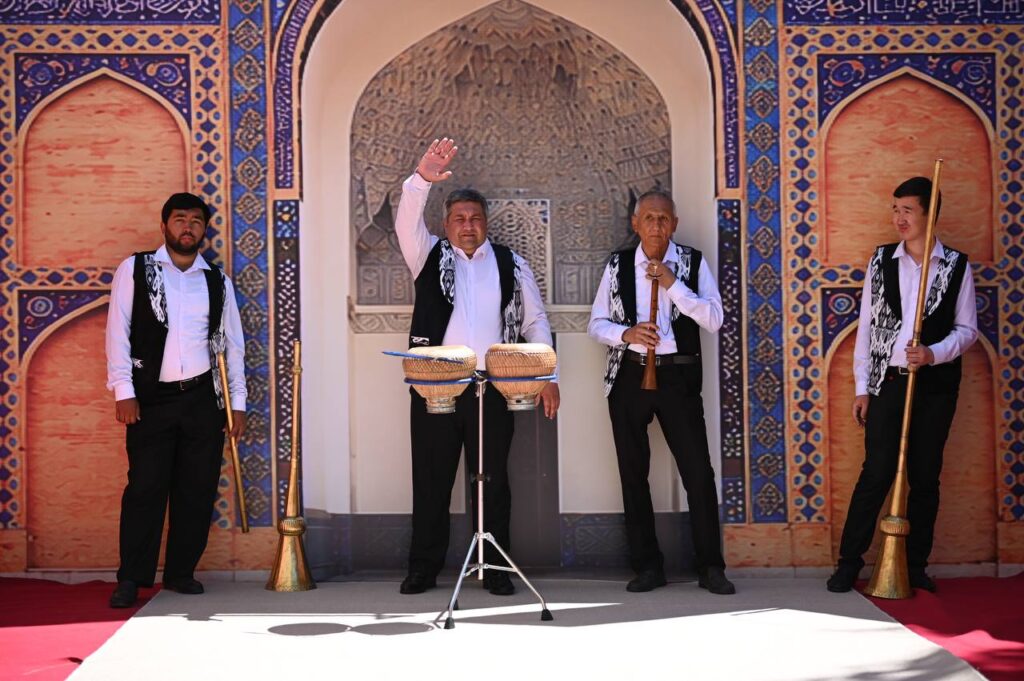
For a moment, past and present melted into one. The scent of qaynatma soup mingled with the sound of a child’s laughter. An elderly professor wiped a tear as a student placed a traditional cap on his head. And somewhere, a doira drum kept beating, steady, joyful, and deeply human. National melodies mingled with the laughter of friends, and ancient customs were revived with fresh enthusiasm, creating a vibrant tapestry that was as much about yesterday as it was about tomorrow. I felt profoundly connected to everything around me.
More Than a Festival, a Tradition of Unity and a Love Letter to Roots

In the end, this gathering was not a one day celebration. It has become a beloved annual tradition at the University of Journalism, one that strengthens community bonds, nurtures shared values, and reminds everyone that spring’s true magic lies not in the flowers but in the act of blooming together. My heart felt full to bursting. The event was a testament to the university’s commitment to fostering tolerance and cultural exchange, where unity was not just an ideal but a palpable, emotional experience.
As the last pavilion folded its carpets and the sun dipped behind the rooftops, guests left with full stomachs and lighter hearts. The girls gathered for one final photograph, their dresses catching the last rays of dusk, red, orange, pink, blue, a final explosion of petals before nightfall. They laughed, hugged, and promised to meet again next year. I watched them with a bittersweet ache, already missing the day that was not yet over.

And as the crowd dispersed, many carried with them a quiet, emotional understanding. That culture, when celebrated with genuine joy, becomes the truest language of peace. But also, that beauty, when worn with pride and grace, becomes a love letter to one’s own roots.
That, perhaps, is the most powerful story of all. And I was there to feel every moment with my entire heart.


